



American Development Model (ADM) Explained
We would like to take a moment to explain the American Development Model (ADM) adopted by USA Hockey and Massachusetts Hockey, why our program follows it, and how it supports the long-term development of your child—both as a hockey player and as an athlete.
We understand that youth hockey has evolved significantly over the years, and with those changes naturally come questions, concerns, and misconceptions. Our goal is to provide clarity, transparency, and reassurance about the path we are taking together.
What Is the American Development Model (ADM)?
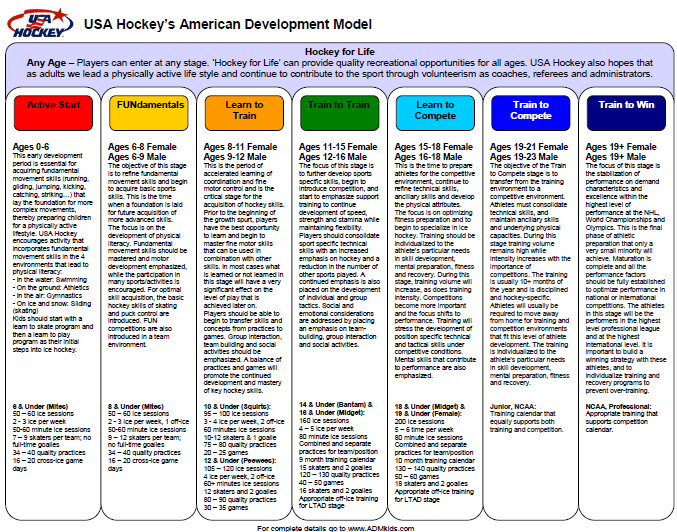
The ADM is a long-term athlete development framework designed by USA Hockey and implemented across state associations, including Massachusetts Hockey. Its primary purpose is to:
* Prioritize skill development over early results
* Align coaching, practice structure, and competition with age-appropriate physical and cognitive development
* Increase retention, enjoyment, and long-term success in the sport
At its core, ADM recognizes a simple truth: Children develop at different rates, and early success does not predict long-term performance.
Station-Based Practices: What are they and how the Comets utilizes them
One of the most visible ADM components you will see in our program is station‑based practices. Rather than having all players perform the same drill at the same time, the ice is divided into stations focused on specific skills.
Key Benefits of Station-Based Practices
* More puck touches: Players are actively involved instead of standing in lines.
* Faster learning: Short, focused stations allow players to repeat skills at game speed.
* Better coaching: Coaches can tailor instruction to the station’s objective.
* Increased engagement: Players stay mentally and physically involved throughout practice.
Each station may focus on skating, puck handling, passing, shooting, or small‑area game play. This mirrors how skills are actually used in games—under pressure, in tight spaces, and with decision‑making required.
Research and long-term development data show that high repetition and active learning environments lead to stronger skill acquisition and confidence as players progress.
Growth & Development: Why We Mix Skill Levels
Another ADM principle you may notice is mixing players of varying skill levels during practices, especially at younger ages. This is done intentionally and thoughtfully.
Why Mixing Skill Levels Matters
* Late developers are protected: Not all players mature physically or cognitively at the same pace. Mixing groups ensures no player is labeled or left behind too early.
* Advanced players still grow: Stronger players develop leadership, adaptability, and creativity when challenged to play with and support others.
* Overall hockey IQ improves: Players learn to adjust to different speeds, skill sets, and situations—an essential game skill.
* Confidence grows across the group: Less experienced players gain confidence by being included, while more experienced players learn problem‑solving rather than relying solely on physical advantage.
Importantly, mixing skill levels does not mean lowering expectations. Coaches adjust challenges within stations to ensure all players are pushed appropriately.
How ADM Supports Skill Development by Age Group
Younger Age Groups (8U / 10U)
At the youngest levels, ADM emphasizes:
* Small‑area games and stations
* High repetition and creativity
* Equal ice time and positional rotation
* Fun, fast‑paced environments that encourage experimentation
The focus is on building a wide base of skills, not early specialization or results.
Middle Age Groups (12U)
As players mature:
* Structure and team concepts are gradually introduced
* Practices remain skill‑focused but become more game like
* Differences in physical development are acknowledged and managed thoughtfully
This stage is critical for retaining players and maintaining confidence during growth spurts and competitive changes.
Older Age Groups (14U and Beyond)
At this point:
* Tactical systems and competition increase
* Players begin to specialize more naturally
* Physical and mental readiness aligns more closely with performance expectations
Because players were developed properly earlier, they are better prepared for higher‑level hockey.
Common Misconceptions About ADM
“Station practices aren’t real hockey.”
In reality, station‑based and small‑area practices more closely resemble actual game situations than traditional line drills.
“Mixing skill levels holds my child back.”
Long-term data shows that players benefit from varied challenges. Early separation often benefits short‑term results but hurts long‑term development.
“Equal opportunity means less accountability.”
ADM environments still emphasize effort, improvement, and discipline—just without early labels that can limit growth.
Acknowledging the Cons and Trade-Offs
ADM is not without challenges:
* Short‑term results may fluctuate
* Progress may be less visible in standings
* Patience is required as development takes time
However, these trade‑offs are intentional—and proven to benefit athletes over the long run.
The Long-Term Outcomes We Are Aiming For
By following ADM principles, our program is working toward:
* Better‑prepared players at older age levels
* Higher retention and enjoyment
* Reduced burnout and injury risk
* Stronger team performance when it matters most
* Players who understand, enjoy, and love the game
Our Commitment to Your Child
We are committed to:
* Development‑first coaching
* Age appropriate expectations
* Open communication with families
* Continuous evaluation and improvement
Your support plays a critical role in this process. When coaches and parents share the same long‑term vision, players benefit most.